A Cape Town business licence is not the same thing as registering a company, and not every business requires the same municipal licence. For the business categories the City identifies as requiring a permit or licence, the premises can be part of the decision: zoning for the intended trade and, for fixed commercial sites, specified clearances and documents can be prerequisites. Official source
That is why “How do I get a business licence?” is often the second question. The first is “What does this exact operation require at these exact premises?”
Who does the City currently list?
The City's current Legal trading and business premises guidance lists a number of activities requiring a permit or licence in Cape Town. These include sellers or suppliers of meals of any sort, certain health facilities and treatments, specified amusement/game-device operations, snooker or billiard tables, cinemas or theatres, adult shopping, and night clubs or discotheques.
This page does not attempt to reclassify an ambiguous business into one of those legal categories. If the intended activity does not clearly fit a listed description, verify the route with the City rather than guessing.
Company registration is a different layer
CIPC/company registration concerns the business entity. A municipal business-licence question concerns whether a regulated activity requires a City permit or licence and, for a fixed site, whether the premises prerequisites are satisfied.
Having a registered company therefore does not prove that a particular activity can operate from a particular property.
The premises documents the City lists for fixed commercial sites
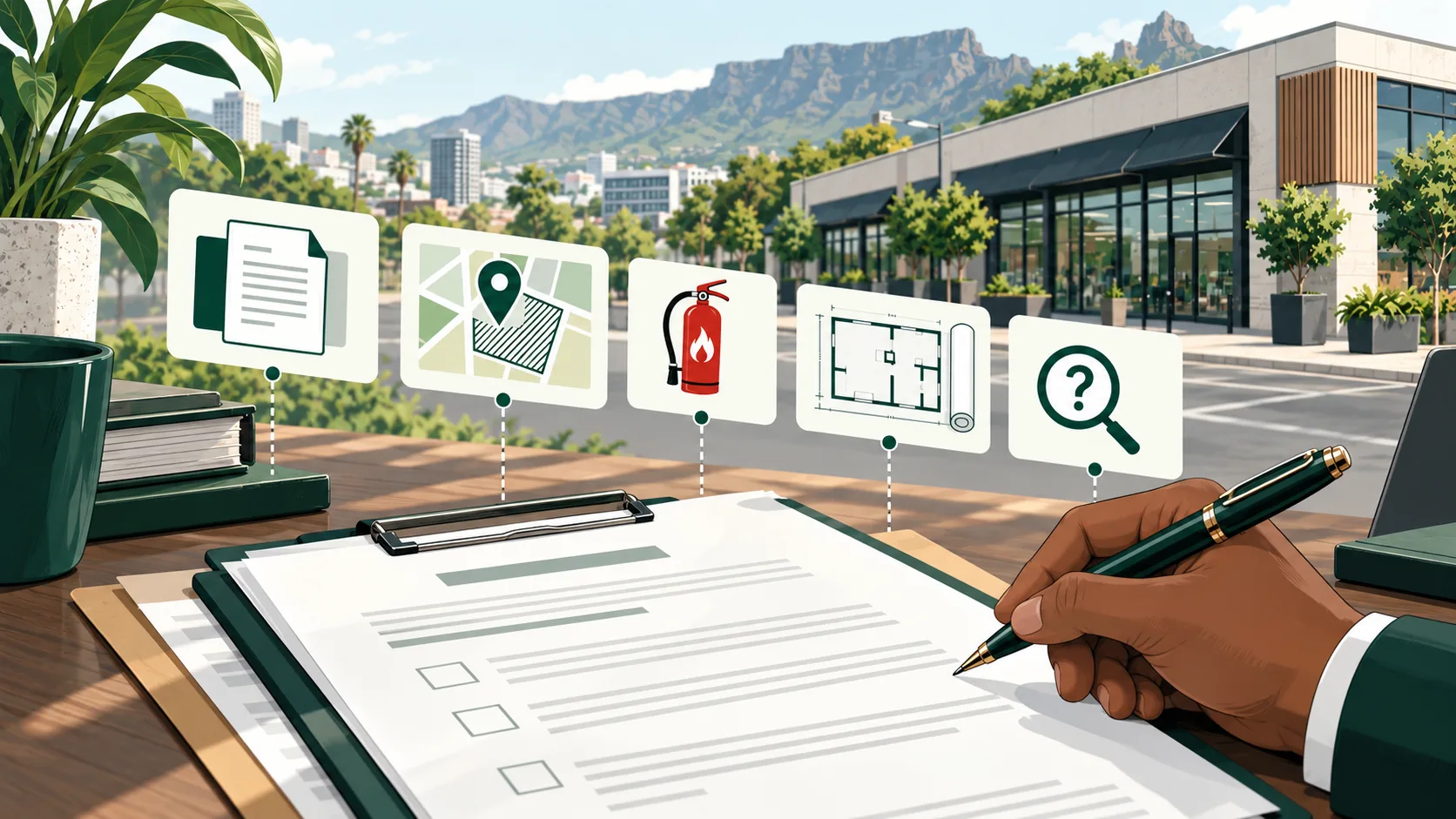
For fixed commercial sites and businesses within the licensing route, the City currently lists the following among the documentation required before a business licence application will be granted:
- land-use clearance certificate;
- population and clearance certificate from the fire prevention officer;
- Certificate of Acceptability;
- approved building plan of the interior layout of the premises;
- specified identity documentation.
The important commercial insight is the dependency chain. A business licence can sit downstream of property and premises evidence rather than being a standalone form you complete after signing a lease.
Why zoning comes first
The same City guidance says that if you are trading on formal property, the business licence will only be granted if the erf/plot is zoned for the type of trade being conducted.
So “the unit is commercial” is not a sufficiently precise answer. The intended activity must be compared with the actual property and applicable use-rights evidence. The business-use zoning guide explains that distinction before the licence question is treated as resolved.
Where the property is zoned General Business, the General Business zoning guide explains why GB1–GB7 do not replace the need to classify the intended activity and resolve any consent or premises-specific conditions.
Food businesses add another premises layer
The City's food-business guidance says formal and informal businesses handling and preparing food for sale to the public require a business licence and that businesses trading in food or beverages also need a Certificate of Acceptability.
The CoA does not replace the rest of the premises decision. National Regulation R638 expressly preserves the need to comply with other relevant local-authority and legislative requirements.
Fire clearance is not just a box on a generic checklist
The City states that minimum fire-safety compliance is one of the prerequisites for a business licence. Whether a specific property satisfies those requirements cannot be inferred from a generic web page or from the presence of fire equipment in a viewing photograph.
What this page can and cannot tell you
THIS PAGE CAN HELP YOU UNDERSTAND
- that not every business licence question is the same;
- which current City licensing categories are relevant to investigate;
- that zoning and premises evidence can sit before licence approval;
- why food, fire and approved-plan questions may be connected.
THIS PAGE CANNOT PROVE
- that your business definitely falls inside or outside a licensing category when the facts are ambiguous;
- that a particular property is correctly zoned for your activity;
- that fire, CoA or approved-plan requirements have been satisfied;
- that private title, lease or body-corporate restrictions allow the operation.
Before you commit
If the business is likely to fall within a licensing category, investigate the premises dependencies before treating the lease as the starting gun. The safest sequence is to understand the exact property, the intended use, the licence trigger and the premises evidence while you still have negotiating room.
Check the premises behind the licence question
Bring the exact property and intended activity into the decision before assuming the licence is a standalone step.