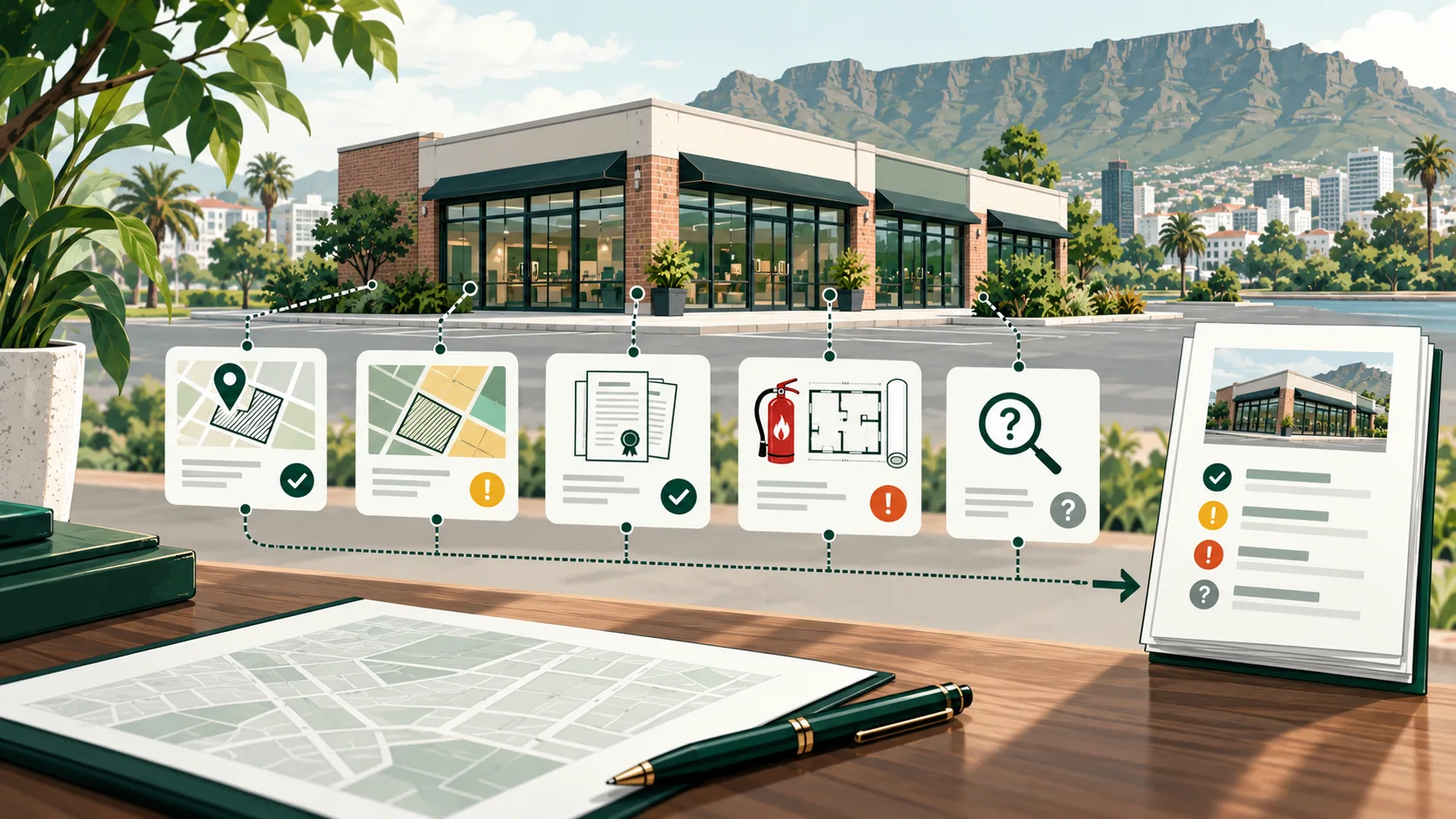
Mzansi SiteCheck is built around a simple rule: an answer should be no stronger than the evidence behind it.
Commercial-premises decisions often fail when several different questions are collapsed into one. A map pin becomes “the property”. A zoning label becomes “approved”. A landlord's assurance becomes “the City allows it”. A Certificate of Acceptability becomes “the restaurant can open”. Missing private documents disappear from the conclusion.
Our method keeps those layers separate.
1. Exact-property identity comes before regulatory inference
A street address or listing coordinate can help locate a premises, but SiteCheck does not treat that alone as authoritative parcel identity.
For address-level assessments, the method first confirms the relevant City cadastral property using the available City identity evidence. Only then should zoning or parcel-specific rules be attached to the premises.
Where a site is split-zoned or otherwise spatially complex, the relevant confirmed premises location must be assessed rather than flattening the whole property into one convenient label.
2. Primary public evidence comes first
The evidence hierarchy is:
Tier 1 — City of Cape Town primary operational guidance, property evidence and application routes.
Tier 2 — South African national legislation, regulations and national-government material where the rule sits above or alongside the municipal process.
Tier 3 — Professional or market sources only as support where primary evidence does not answer the question. They do not override primary authority.
Tier 4 — Community discussion may show where users are confused, but it is not used as authority for a rule.
3. The intended operation matters
SiteCheck does not infer regulatory consequences from a broad label such as “commercial property”. It asks what business the user intends to operate and which operational facts can change the route.
For example, a restaurant assessment may need different facts from an office assessment. Food handling, customer seating, extraction, equipment, alterations and other operational details can affect which premises questions need to be answered.
4. A planning result is not overall premises clearance
The product keeps three decision surfaces separate:
A. LAND-USE SCREEN
What the public zoning and land-use evidence supports about the intended use.
B. BUSINESS-OPENING REQUIREMENTS
Which licensing, food, fire, building or other opening requirements appear relevant to the described operation.
C. OVERALL PREMISES CLEARANCE
Whether the evidence is sufficient to establish overall premises readiness.
The third surface remains NOT VERIFIED unless the necessary evidence has actually been established. A PRIMARY base-zoning result is not promoted into full clearance.
5. “Not proven” is a valid result
Important premises evidence can sit outside the public dataset. Examples include:
- title restrictions;
- historic land-use conditions;
- approved building plans;
- occupancy or permission-to-use evidence;
- sectional-title or body-corporate rules;
- lease restrictions;
- other private approvals or premises facts.
If an item cannot be established safely, SiteCheck keeps it visible as VERIFY / NOT PROVEN rather than filling the gap with an assumption.
This is deliberate. Uncertainty is decision information.
6. Public rules and user-supplied facts stay distinguishable
The public evidence may say which rule applies if a fact is true. The user may still need to confirm whether that fact describes the actual operation.
For example, a rule may depend on food preparation, alterations or a particular use. The method records those operating facts separately so an unsupported assumption does not silently become regulatory evidence.
7. Freshness and provenance are part of the answer
Public guidance changes. SiteCheck therefore records the source and evidence-review date behind material rules rather than presenting every statement as timeless.
The current Wave-A source graph was reviewed on 7 September 2026 and prioritises:
- City of Cape Town — Land use and zoning;
- City of Cape Town — Legal trading and business premises;
- City of Cape Town — Regulations for food businesses;
- City of Cape Town — Certificate of Acceptability guidance;
- City of Cape Town — Request a fire inspection;
- City of Cape Town — Submit a building plan;
- National Department of Health — Regulation R638 of 2018.
8. What Mzansi SiteCheck is not
It is not:
- an official City zoning extract;
- a municipal approval or clearance certificate;
- legal advice or a lease review;
- a replacement for a planner, architect, fire professional, environmental-health practitioner, lawyer or other professional where one is required;
- proof that a landlord or body corporate permits the activity;
- proof that every historic approval or private restriction has been identified.
It is a structured premises-readiness decision layer designed to show what the public evidence supports, what requirement may follow, and what still needs to be verified before money moves.
9. Search pages do not become fake evidence inventory
Indexable Mzansi SiteCheck content is deliberately limited to useful editorial and decision pages. Dynamic property results, session URLs, checkout/payment pages, private staging, machine-generated address pages, internal test routes and query-parameter duplicates are not intended to become SEO inventory.
The goal is not to manufacture thousands of thin location pages. It is to make a smaller number of decision-rich pages and, when the address-level checker is public, connect them to property-specific evidence that generic articles cannot reproduce.
The standard to hold us to
For any material premises conclusion, you should be able to ask:
1. Which exact property are we talking about?
2. Which intended business and operating facts are being assessed?
3. Which primary source supports this rule?
4. What does that source actually prove?
5. What does it not prove?
6. Which evidence is still missing or private?
7. What should be verified before commitment?
If the answer to those questions is not visible, the conclusion is too strong.
See the premises decision process
Start with the exact property, intended business and the evidence boundary — not a generic green light.